Tuesday, November 29, 2016

Black footed ferrets (Zahayra Carino)


Mustela nigripes

Because we live in a state where this species is illegal, we tend to forget the importance of black footed ferrets. Due to the decline in their prey, prairie-dogs, black footed ferrets have been changing habitats and rapidly decreasing in population.


Image: http://blog.nature.org/science/2016/01/04/recovery-hope-black-footed-ferrets-most-endangered-mammals/


The black-footed ferret or also known as, Mustela nigripes, is a medium-sized mustelid, weighing
about 1.4–2.5 pounds and measuring 19–24 inches in total length. The upper body parts are yellowish buff, sometimes whitish; feet and tail tip are black; and a black “mask” across the eyes. Black footed ferrets were normally found in the Great Plains, mountain basins, grasslands or basically wherever their prey, prairie-dogs, were located. Because of the exotic disease, sylvatic plague, that was introduced to prairie-dogs, black footed ferrets were extirpated from these ranges. After this species went nearly extinct in the late 1980s, the success of massive efforts to reintroduce this species back to its native habitat have made captive breeding successful. According to ICUN, several hundred individuals exist in six different breeding facilities and as of early 2015, about 500 wild-living black footed ferrets exist in populations in several US states and Mexico. The reintroduction of this species started in 1991 and since 1987 over 8,000 kits were produced through captive breeding. As of 2015, there are currently 206 black-footed ferrets and in order to manage this species, they are sampled and counted at least once a year. 


image: http://thezt2roundtable.com/topic/10781187/1/

Because of its very small and restricted population, black-footed ferrets were listed as endangered in the year 1967 and again in 1970, which received a level 2C listing. This means that the ferret faces a high degree of threat with potential economic conflicts and reflects the ferret’s taxonomic status as a full species. There are three different reasons that the black footed ferrets are endangered: a conversion from native range to cropland, poisoning of prairie dogs to reduce competition with domestic livestock for forage and lastly because of the sylvatic plague that affected the prairie-dogs, all leading to why the black footed ferrets were listed in the level of 2C.

From Region 6 U.S and Wildlife Service, the recovery plan made to help these black footed ferrets is as follows:
  •  Conserve and manage a captive breeding population of black-footed ferrets with a minimum of 280 adults (105 males, 175 females) distributed among at least three facilities.
  • Establish free-ranging black-footed ferrets totaling at least 1,500 breeding adults, in 10 or more populations, in at least 6 of 12 States within the historical range of the species, with no fewer than 30 breeding adults in any population, and at least 3 populations within colonies of Gunnison’s and white-tailed prairie dogs.
  • Maintain these population objectives for at least three years prior to downlisting.
  • Maintain approximately 247,000 acres (ac) (100,000 hectares (ha)) of prairie dog occupied habitat at reintroduction sites (specific actions are described in Part II of this plan) by planning and implementing actions to manage plague and conserve prairie dog populations.
What can you do to help these adorable ferrets? We can first start by helping prevent any type of human destruction of prairie dog colonies. This will increase the population of prairie dogs and before you know it, help the black footed ferrets from further declining. For different ways of reaching out and taking part of helping this species, you can click the link below https://www.defenders.org/black-footed-ferret/how-you-can-help

Works Cited

Basic Facts About Black-Footed Ferrets. (2016). Retrieved November 29, 2016, from http://www.defenders.org/black-footed-ferret/basic-facts

Support the. (n.d.). Retrieved November 29, 2016, from http://www.iucnredlist.org/details/links/14020/0

Santa Barbara County Distinct Population Segment of the California Tiger Salamander (Ambystoma californiense) by Christina Cazares

It is incredibly easy to forget about the organisms that we do not encounter on a day to day basis. They remain hidden away from our sight, but are often integral to the successful workings of an environment. This is definitely the case with an organism fairly local to us in San Luis Obispo: the Santa Barbara County Distinct Population Segment (also known as DPS) of the California Tiger Salamander, formally, Ambystoma californiense. As metamorphs (living on land and in water) their status is worrisome as their well-being impacts the health of both the terrestrial and aquatic ecosystems surrounding them.  
Image from: http://cdn2.arkive.org/media/9A/9AC270B2-BBB2-4F02-A879-6CB3F162A803/Presentation.Large/California-tiger-salamander-close-up.jpg 
Description and Ecology 
The California Tiger Salamander starts its humble life during California’s rainy season, in January and February, as a small egg attached to twigs or grass in a vernal pool. This egg hatches into a yellowish-gray larva after two to four weeks. While they are this small, the larvae feed on zooplankton, small crustaceans, and insects. As they grow larger, they start to consume the tadpoles of other amphibians, spiders, and earthworms. It takes about three months for them to grow into salamanders with this species’ characteristic stocky body, blunt and rounded snout, and black coloring with white or yellow markings (as can be seen in the photo above). From this phase, the California Tiger Salamander is no longer confined to vernal pools and it is free to migrate to cool, wet grasslands and woodlands, where it will live in underground burrows abandoned by other animals. This underground, nocturnal life provides a safe haven for these salamanders to continue to grow for four to five years, until they are 6-9 inches long and have reached breeding maturity.
Some fun facts about the ecology of the California Tiger Salamander:
1.“Recent genetic studies show that there has been little, if any, gene flow between the Santa Barbara County DPS and other populations for a substantial period of time,” this is because California Tiger Salamanders will go out of their way to migrate back to the same vernal pool they were born in when it comes time to breed--sometimes making journeys as far as 1.2 miles (“U.S.”).
2. Adult California Tiger Salamanders spend a quarter of their lives underground.
Geographic and Population Changes, Listing Date, Type of Listing, Threats
The Santa Barbara DPS of California Tiger Salamanders are currently found in six metapopulation areas, that can be seen below, within these areas are sixty known and consistent breeding ponds.
On January 19, 2000, this species was emergency listed as endangered. Earning a 3C on the U.S. Fish and Wildlife endangered species scale means that within these areas, there is a high potential for the recovery of this organism. With implementation of this recovery plan, it is estimated that the Santa Barbara DPS of the California Tiger Salamander could shed its endangered status by 2045. The “C” part of its rating means that its primary threat is, “construction or other development projects or other forms of economic activity,” (“U.S.”). In conjunction with the habitat loss from urbanization, this salamander faces several other perils to its survival. Climate change has caused the vernal pools that are normally the salamanders’ breeding grounds to dry up much earlier, or fail to exist altogether. Without proper breeding grounds, reproduction decreases significantly, along with the survival rates of the existing larvae. This aspect is devastating to the population of this species. Because they take up to five years to reach breeding maturity they naturally have low reproduction rates, with less than 50% of California Tiger Salamanders surviving to breed more than once. Another danger to their existence is biologists’ limited knowledge of their terrestrial life. For a majority of their life, this organism lives underground where it is difficult to monitor their day-to-day existence. This makes it difficult to conclude the best possible ways to help their endangered status.
Recovery Plan
The recovery strategy being implemented to ensure the survival of this species focuses heavily on preventing the urbanization of known breeding grounds in order to preserve vernal pool habitats. Santa Barbara County is also working towards creating education programs about necessary habitat conservation methods in order to generate support from both the general public and private landowners who inhabit the salamanders’ environment.
What can you do to help and what are other resources containing information about the Santa Barbara DPS of the California Tiger Salamander? 
The general public has to make the conscious effort to prevent construction projects in areas known to contain vernal pools rather than exploit the economic advantages that may be possible. Protecting these areas will ensure that the salamanders have sufficient breeding grounds. For more information on this species and their conservation visit Sacramento Fish and Wildlife Service’s page specific to this topic: https://www.fws.gov/sacramento/es_kids/CA-Tiger-Salamander/es_kids_ca-tiger-salamander.htm
Works Cited
"Saving the California Tiger Salamander." Center for Biological Diversity. N.p., n.d. Web. 29 Nov. 2016. <http://www.biologicaldiversity.org/species/amphibians/California_tiger_salamander/>.
Swenty, Sarah, External Affairs Divison, Sacramento Fish & Wildlife Office. "Species Information, California Tiger Salamander." Sacramento Fish and Wildlife. N.p., n.d. Web. 29 Nov. 2016. <https://www.fws.gov/sacramento/es_species/Accounts/Amphibians-Reptiles/es_ca-tiger-salamander.htm>.
U.S. Fish and Wildlife Service. 2015. Draft recovery plan for the Santa Barbara County Distinct Population Segment of the California tiger salamander (Ambystoma californiense). U.S. Fish and Wildlife Service, Pacific Southwest Region, Ventura, California. vi + 76 pp.


Monday, November 28, 2016

Aaron Capinpin Ocelots

 Aaron Capinpin

Ocelots

Description and Ecology of Ocelots

(From Source 2)
     The ocelot (Leopardus pardalis) is a medium sized cat that is also solitary and territorial. Ocelots may weigh from 7-16 kg. The spots on the ocelot’s body are shaped like unlinked chains. As you look lower on the ocelot's body, the spots become more circular. Also located on the ocelots face and neck are vertical stripes. On its tail there are rings of black that may or may not fully reach around its tail.

Ocelot Approaching
(From Source 3)
     Ocelots are a generalist species. This means that they have the ability to eat a wide variety of other species. So, when an ocelot hunts it may hunt from trees, the ground, or in water, eating either fish, birds, or other mammals. The ocelots are usually nocturnal and are active 12-14 hours per day. During the daytime, they rest in brush piles, clumps of vines or in between the roots of large trees. When ocelots are not hunting, their movements become cryptic. Many researchers still do not comprehend the patterns of the ocelot’s activity.

Geographic and Population Changes

Image result
(From Source 4)
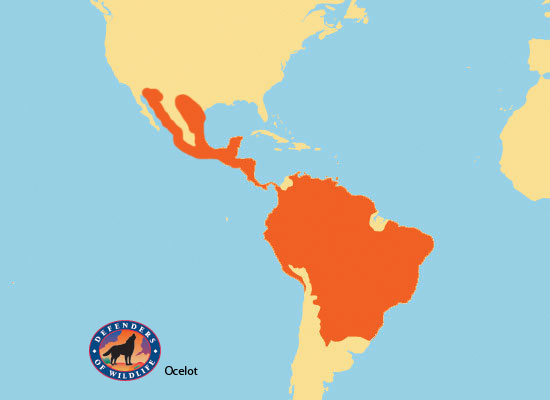
     The Ocelot currently ranges from south Texas and Sonora to northern Argentina and Uruguay. However, its range in historic times was considerably greater. In the 1800's, the Ocelot occurred throughout the state of Texas and also in parts of the states of Arkansas, Louisiana and Arizona. In the U.S. there are fewer than one hundred ocelots. Worldwide, there are an estimated 800,000 to 1.5 million ocelots.


Listing Date and Type of Listing

The ocelot was listed as endangered in 1972 under the authority of the Endangered Species
Conservation Act of 1969 (Source 1).

Cause of listing and Main threats

     Like many other endangered species, the ocelot faces similar threats: habitat loss and fragmentation. The main sources of these two are from the need of the agriculture industry for farmland and the construction of new roads. This duo causes the ocelots to separate; separation in turn leads to loss of genetic diversity and a decrease in the ocelot population. Along with that, roads are dangerous for another reason: vehicles. Cars threaten ocelots by turning them into roadkill. Another threat to the ocelots are humans. In the mid 1900s, ocelots were being killed illegally. Humans sought ocelot pelts, especially those in the fashion industry of the time. Also, ocelots were being taken from the wild to become pets.


Recovery Plan

The objective of the plan is to withdraw the ocelot from the list of threatened and endangered species by ensuring the ocelot population's lasting survival through the revitalization and protection of the ocelot populace and protection of their habitat. The steps needed to achieve this goal are:

1. Estimate the necessary habitat space required and safeguard that habitat so that it may maintain a reasonable population of ocelots in the border region between the U.S. and Mexico.
2. Curb the effects humans have when developing on ocelot habitats.
3. "Maintain or improve genetic fitness, demographic conditions, and health of the ocelot"(Source 1).
4. "Assure the long-term viability of ocelot conservation through partnerships, the development and application of incentives for landowners, application of existing regulations, and public education and outreach"(Source 1) .
5. "Practice adaptive management in which recovery is monitored and recovery tasks are revised by the USFWS in coordination with the Recovery Team as new information becomes available"(Source) 1).
6. "Support international efforts to ascertain the status of and conserve the ocelot south of Tamaulipas and south of Sonora"(Source 1).

What can you do?

Be Aware! Support the cause here :
https://support.worldwildlife.org/site/SPageServer?pagename=donate_to_charity

Other Resources

Wanna look at cool ocelot pictures? 
Look here http://animals.nationalgeographic.com/animals/mammals/ocelot/

Wanna look at even more ocelot pictures!?!
Look here http://twistedsifter.com/2011/12/adorable-ocelot-30-pics/

Works Cited

1. Service, U.s. Fish & Wildlife. "Recovery Plan for the Ocelot (Leopardus Pardalis) First Revision." (n.d.): 1-237. July 2016. Web.

2. "Ocelot." FELID TAG. N.p., n.d. Web. 28 Nov. 2016. <http://felid-tag.org/ocelot/>.

3. "News Releases." Rainforest Rodents Risk Their Lives to Eat | Newsdesk. N.p., n.d. Web. 28 Nov. 2016. <http://newsdesk.si.edu/releases/rainforest-rodents-risk-their-lives-eat>.

4. Https://www.facebook.com/DefendersofWildlife/. "Basic Facts About Ocelots." Defenders of Wildlife. N.p., 14 Oct. 2016. Web. 28 Nov. 2016. <http://www.defenders.org/ocelot/basic-facts>.

The San Joaquin Kit Fox (Vulpes macrotis mutica), a very adorable fox that looks exactly like my dog and therefore my affection extends to this cute species.

Cameroon Clawless Otter (Nikolina Cargonja)


Help the Cameroon Clawless Otter

The Cameroon Clawless Otter is listed under the Federal Listing Status as an endangered species. This species of otter is a subspecies of the African Clawless otter, part of the mustelidae family, located in Congo basin in Central Africa.
Because of its isolation in the mid part of Africa, very little is known about the species, but what we do know is this; The Clawless Otter lives in a wetland habitat, specifically in the rainforests of the Congo, including some form of a swamp and or rivers, that is commonly surrounded by lakes. You will most likely find these otters resting along cavities along river banks during the day, as they are a nocturnal and solitary species. Living in such a habitat, the clawless otter is a skilled swimmer and preys on a variety of water organisms such as fish and crabs. In addition to the water organisms, judged by their teeth structure, it has been suggested that the clawless otter also prey on terrestrial species such as earthworms and amphibians. It has also been noted that the Clawless otter spends much more time on land than other otters. The Clawless Otter averages a weight of 20kg, fully maturing at the age of 1 years old. Their average head/body length is 150 cm, giving them a lengthy body structure with short limbs and a tapering tail. Their feet are unwebbed and the front toes are clawless, hence giving them their name as the Cameroon Clawless Otter. Contrary to most other otters, the Clawless have a more slender neck/head and smaller teeth. Their fur is dark brown with silvery tips on the head and shoulders.
Although protected by the Convention of International Trade In Endangered Species of Wild Fauna and Flora (CITES) for trading over their thick, velvety, fur, these otters are still being threatened for a number of reasons. One common threat to the Cameroon Clawless Otter comes from local hunters, hunting for bushmeat, which is believed, by the locals, that their meat provides purported, magical, powers and as a aphrodisiac in traditional medicines. This belief originated from Gabin, where the reputation of the otter has been known to be very difficult to catch, and if one were to wear a piece of their fur, they would become invisible to their opponent, or have the ability to escape their enemies, as otters escape fish traps. This threat is one of the key factors that has caused them to become endangered in such an isolated habitat in Africa. In addition to hunting for bushmeat, fishermen also play a role in the Clawless otter’s endangerment by hunting them down and killing them, not for their meat, but because they perceive the otters as competition over their fish stocks.
Last but not least the otters are threatened due to the deforestation and therefore degradation of their habitat. Due to these threats, the Cameroon Clawless Otter has undergone a severe decline in population. Unfortunately, these otters are only protected at an international level under the CITES treaty, formed in 1973, but because of the ongoing local hunting, local legislation and enforcement will be needed to help protect these otters from eventual extinction. From the information gathered, I believe the Cameroon Clawless Otter is an overlooked species and has not been studied enough by scientists based on the lack of information. This makes it that much more difficult to make any movements to help protect and save these otters. In order to truly help these creatures, the Cameroon Clawless Otter must become more known to the world so that they can get the protection they need.


Bibliography

"Congo Clawless Otter: Aonyx Congicus - ARKive." N.p., n.d. Web. 28 Nov. 2016.

Entertainment, SeaWorld Parks &. "Congo Clawless Otter." MindComet, Inc. - Http://www.mindcomet.com. N.p., n.d. Web. 28 Nov. 2016.

"Aonyx Congicus (Lönnberg, 1910), the Congo Clawless Otter." IUCN OSG - Aonyx Congicus. N.p., n.d. Web. 28 Nov. 2016.

"Support the." Aonyx Congicus (Cameroon Clawless Otter, Congo Clawless Otter, Small-clawed Otter, Small-toothed Clawless Otter, Zaire Clawless Otter). N.p., n.d. Web. 28 Nov. 2016.


Polar Bears (Jackie Buckman)

Tragedy in the Tundra; 

a comprehensive analysis of what factors led to the alarming decline in Polar Bear populations within recent years, and what must be done in order to facilitate a sustainable recovery of the species.
image courtesy of: https://uhsanimalsavers.files.wordpress.com/2012/09/10224221c-3_e589afe69cac.jpg
 

Ecology of the Polar Bear  

Native to the frigid climate and ice infested waters that encompass the northern hemisphere, specifically in parts of Canada, Denmark, Norway, Russia, and the United States; polar bears are the physically largest members of the bear family. Similar to the Grizzly, who polar bears actually evolved from originally, they are textbook carnivores and feed primarily on several different kinds of seal. The species is often labeled to have a low reproductive rate because of the combination of factors including their late age at sexual maturity (females typically around 4-5 years of age) , minimal litter sizes (generally only two cubs), and the level of extended parent supervision over their young. 


Geographic & Population Changes

According to reports released by the US Fish and Wildlife Service, the current global Polar Bear population is somewhere between 20,000 to 25,000 individuals ranging across the five Arctic Nations. In the last several decades, there has been significant fluctuation in the data regarding geographic and population tendencies of the Polar Bear. However, it is difficult to draw conclusions from these changes in data that is applicable to the entire species. Most published reports focus only on variations occurring within a single sub population of the 19 various populations in existence. 

Date and type of listing received

Polar Bears were first classified as a 'threatened' species on May 15, 2008.


Main Threats / Factors that caused the listing

The overbearing threat to the survival and recovery of Polar Bears is the drastic, rapid degradation of the ice caps they use as a habitat, which is a product of Arctic warming. This means that the primary threat to Polar Bear survival is whether or not decisive action can be taken against the increasing concentrations of greenhouse gasses being released into the atmosphere. Experts in the field agree that if this is not accomplished in the relatively near future, the Polar Bears will have almost no chance of survival.


Description of Recovery Plan

The foundation of the recovery strategy drafted for the species is a fierce opposition effort to Arctic Warming and relies on decisive action to facilitate massive reductions in the amount of greenhouse gas being emitted into the atmosphere. Apart from this, the USFWS Conservation Strategy also touches on several other areas for conservation management which include actions like monitoring and limiting human-bear conflicts, subsistence harvest, guarding the diminishing environment, and protection from contamination of waste or oil spills. These efforts are all important to stay vigillant about so that if/when effective climate reform is accomplished, the species will have optimal chance for recovery.  


What you can do 

- Make changes in your daily life that reduce your carbon footprint (bike to work instead of driving, don't idle, etc)
- Research and Educate others about the issue
- Donate to conservation efforts
- Advocate for legislation regarding carbon emissions

Other resources 

Polar Bears International

World Wildlife Fund - Polar Bears